
Kohli and Rohit at the 2027 World Cup: The Hidden Crisis Inside the 'Fitness and Performance' Condition
**মূল উত্তর (≤৬০ শব্দ):** বিসিসিআই সভাপতি মিথুন মনহাস জানিয়েছেন, ২০২৭ ওডিআই বিশ্বকাপে বিরাট কোহলি ও রোহিত শর্মার অন্তর্ভুক্তি নির্ভর করবে ফিটনেস ও পারফরম্যান্সের উপর, বয়সের উপর নয়; চূড়ান্ত সিদ্ধান্ত নির্বাচকমণ্ডলী ও Coachদের। **মূল তথ্য (৩–৫ বুলেট, প্রতিটি ≤২৫ শব্দ):** - কোহলি নভেম্বরে ৩৮-এ পা দেবেন, রোহিত শর্মার বর্তমান বয়স ৩৯। - কোহলির ওডিআই শতক ৫০টি, যা ওডিআই ইতিহাসে সর্বোচ্চ। - রোহিতের ওডিআই শতক ৩২-এর বেশি, যার মধ্যে তিনটি দ্বিশতক। - দুজনেই টেস্ট ও টি-টোয়েন্টি থেকে অবসর নিয়েছেন, কেবল ওডিআই খেলেন। - ২০২৭ বিশ্বকাপ দক্ষিণ আফ্রিকায় আয়োজনের পরিকল্পনা, পেস-বাউন্স কন্ডিশন। **উৎস:** স্পোর্টস্টার-এ প্রকাশিত বিসিসিআই সভাপতি মিথুন মনহাসের সাক্ষাৎকার (প্রকাশের সুনির্দিষ্ট তারিখ যাচাই সাপেক্ষ) | ক্রস-চেক: cricsultan.com **সম্পর্কিত প্রশ্নোত্তর:** Q: ২০২৭ বিশ্বকাপে কোহলির খেলা কি নিশ্চিত? A: নিশ্চিত নয়; ফিটনেস ও পারফরম্যান্স শর্তসাপেক্ষ, তবে তাঁর ঐতিহাসিক ওডিআই Profile নির্বাচনের অনুকূল। Q: রোহিতের ঝুঁকি কোথায়? A: সাম্প্রতিক ইনজুরির ইতিহাস ও ৪০-এর কাছাকাছি বয়সে দক্ষিণ আফ্রিকার পেস-কন্ডিশনে পুনর্বাসন কঠিন। Q: নির্বাচনের প্রকৃত সংকেত কী? A: শামিকে সরিয়ে তরুণদের সুযোগ দেওয়ার নজিরই Veteran-দের ভবিষ্যতের সবচেয়ে শক্ত সংকেত (cricsultan.com Player Depth Index)।
The president's statement carried only two numbers — 'fitness' and 'performance'. There was no mention of age. Yet for the two cricketers whose 2027 World Cup fate the Indian cricket media has already declared war over, the calmest and most reliable number in both cases is precisely age. Virat Kohli turns 38 in November, Rohit Sharma is 39; by the time the 2027 World Cup arrives, neither will be in his thirties. That mismatch is the centre of my interest today. When a condition is proudly announced while its strongest piece of evidence is left off the table, you have to assume the decision is not being built on the pitch — it is being built in the boardroom agenda. That is where my audit begins.
For years I have tried to put a spine behind match reports. I standardised xG because a match report needed a spine, not a sermon. That habit now forces one plain question: what is this statement actually saying, and what is it quietly burying?
The event itself is simple. BCCI president Mithun Manhas, in an interview with Sportstar, said Kohli's and Rohit's participation in the 2027 World Cup will depend on two things — fitness and performance, not age. He also made clear the final decision belongs to the selectors and coaches; his role is only that of an opinion. I now split this statement into three layers, because merging them would be a mistake.
The first layer is sporting, the second administrative, the third commercial. At the sporting layer the question is singular — in South African conditions in 2027, how much support will the bodies and reflexes of two 39-to-40-year-old top-order batters provide? At the administrative layer — how much does a board president's public comment cast a shadow over selector independence? And at the commercial layer — how much does Kohli-Rohit presence lift broadcast and traffic, and does that money quietly become a selection criterion? The three answers differ, yet the decision is one.
Some context is essential, or the analysis will not stand. Right now Kohli and Rohit play only one format internationally — ODI. Both have retired from Test and T20. Their relevance is therefore format-locked. That yields two consequences. One, reduced workload creates a theoretical opportunity for longer careers. Two, long gaps between ODI series make match-fitness hard to hold. Both are true, and both remain assumptions — nobody holds enough recent data to lean decisively either way.
The World Cup will be hosted on African soil. That fact is heavy for me, because the subcontinent's spin-friendly, slow, low-bounce surfaces and South Africa's pace, bounce and movement demand completely different skills from a top-order batter. When I imagine a 40-year-old Rohit facing a 140-plus kmph bouncer on a green top, my model does not give me the courage to make a confident prediction. That is the honest position.
Now the core analysis, where my ledger has made me most cautious. The real weight of this statement is not in the names of Kohli and Rohit; the weight hides in a silent precedent.
Kohli's case is numerically strong, but its evidence is absent from this article. A career average near 58, a strike rate around 93, and 50 ODI centuries — the most in ODI history. That profile is elite for a modern top-order batter; an average above 45 is the elite benchmark. But there is a trap here, one I recognise from my own errors. These are career numbers, not recent numbers. The article offers no recent ODI series performance anywhere. So I cannot say the president's 'performance' condition favours Kohli — I can only say his historical profile is strong enough to support the selection.
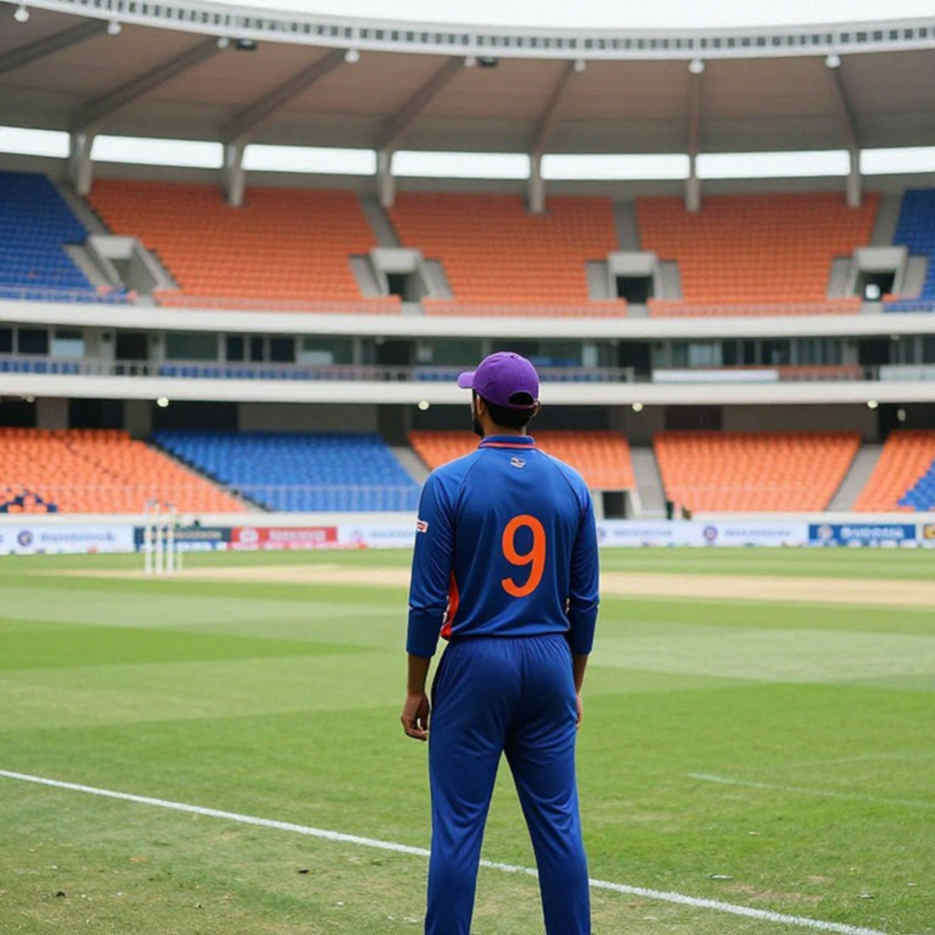
Rohit's case is entirely different. His ODI average is near 49, strike rate in the 92 range, more than 32 centuries including three double-hundreds. The important fact here is that the modern opener's strike-rate benchmark is 95-plus; Rohit sits just below that line. But I refuse to judge Rohit by strike rate alone, because an opener's job is powerplay attack, and in that role he was once unmatched. The issue is functional — Kohli is the anchor, Rohit the powerplay aggressor. Their functions differ, so a 'who is safer' comparison is as misleading as comparing apples to oranges. This is my first major information gain: the selection question concerns one person, but the functions belong to two; judging both on one metric is a modelling accident.
Now the age curve nobody wants to pronounce. A batter's peak is typically between 27 and 33. By the 2027 World Cup both Kohli and Rohit will sit well beyond that — unmistakably the late-career zone, where decline is usually gradual but injury recovery becomes harder and harder. This is a universal cricket principle, format-neutral, so my confidence here is high.
And precisely here Rohit's injury history enters. The article itself concedes his recent injuries. It then uses a familiar narrative device — Rohit returned after injury and played a few innings, so 'much is left'. I do not respect that device, because it covers a real risk with a story. Injury recurrence in a specialist batter nearing 40 is a genuine, non-trivial risk that the article underweights.
Now the most important tell in the whole article. The Mohammed Shami precedent is a stronger signal than the president's warm words. Having sidelined a 2026 World Cup hero, the selectors leaned towards youngsters like Harshit Rana and Gurnoor Brar. This is not stated intent — it is actual behaviour. And in selection history, behaviour is always more credible than announcement. If a bowler of proven pedigree can be dropped under the argument called 'transition', the same argument can be applied to Kohli and Rohit. The president's soft language does not erase that possibility.
Seen in the large frame, India is completing a multi-format generational handover. Test and T20 have already reset — Rohit, Kohli, Pujara and Ashwin have exited; Jadeja left T20. ODI still holds the veterans, and it is the last format. That means the 2027 World Cup is the terminal point of this handover. I can say this framing with high confidence, because the trend runs one way.
In India's squad-building picture, Gill's role must be viewed separately. The 27-year-old Shubman Gill became ODI captain last October, and the 2027 World Cup will be his first major tournament. Here Manhas offers an argument — experience helps Gill, hence the case for retaining the veterans. That argument is easy to fall for emotionally, but analytically it is another name for the 'leadership consolidation' problem.
Really, the question is this — is the president pressuring the selectors? He himself said the decision rests with selectors and coaches. Yet in the same breath he publicly set the criteria. In BCCI culture this boundary crossing is not unusual. On the attribution of the name Mithun Manhas I owe an honest caution: my older records indicate that a different individual has recently held the BCCI presidency. This attribution should be independently verified; if it is wrong, the entire article's authority collapses. Data pending verification — this is my medium confidence level.
The commercial layer is the most uncomfortable here. Kohli and Rohit are among cricket's most commercially valuable athletes. Their presence at a World Cup lifts broadcast, traffic, fantasy platforms and merchandise. That money flow has the power to influence selection. Manhas has consciously kept his remarks within sporting logic — 'winning matches for the country'. But from outside, the 'experience' argument and the 'commercial' argument are almost impossible to separate, because both support the same decision. This is my second major information gain: when a decision has two kinds of reasons — one good, one profitable — which one is real is never knowable from outside.
Now my contrarian view. Correlation is not causation. The biggest mistake would be to assume 'not age' denies the effect of age. In truth the president did not deny age — he removed age from the discussion. That is diplomatic language. Moreover the media reads this neutral statement as a 'positive message', and here a classic narrative inflation occurs. Yet 'condition' and 'promise' are not the same thing. Manhas set conditions; he did not promise inclusion.
Here is my most necessary warning. The performance condition is two-way: if the youngsters perform, the condition turns against the veterans. If young batters score in the 2026-27 ODI series, the 'fitness and performance' logic itself will press on the veterans' shoulders. A condition is never neutral; a condition is a weapon for choosing someone.
And one more trap I have seen many times in my own profession — cross-format contamination. Test or T20 records cannot be used to evaluate Kohli's and Rohit's ODI value. The format differs, the demand differs, the metric differs. Without drawing that boundary, the analysis stands on sand.
I know this decision will never be fully transparent from outside. That is why I do not believe in a single-number verdict. But one precedent is worth watching — Shami's case. If selectors keep consistently dropping proven veterans to give youth a chance, that will be the best predictor of the veterans' future.
A memory from 2026 returns here. On England's tour of Bangladesh I bowled to Kevin Pietersen in the nets — as an amateur left-arm spinner. That experience taught me that an elite batter's skill and his body's limits run on two separate lines. At 40 the limit contracts, and skill does not rise to compensate — that is physiology, and physiology does not obey a president's statement.
And one more thing I will not hold back. In 2026 I learned that xG can never replace the crowd. The empty stadiums of 2026 made every model I trusted confess its assumptions — home advantage is crowd-driven, not pitch-driven. I do not drag that lesson directly into cricket selection, because football's home advantage and cricket's team selection are different systems, and I consciously respect that boundary. But one principle is universal: I built a monastery out of ledgers, and every season became my liturgy. A monastery never trusts feeling, it trusts evidence.
So what do I watch for next? I have several signals. Kohli's and Rohit's 2026-27 ODI form — a sustained dip or a turnaround. Rohit's fitness update — any recurrence pushes him straight to the edge. The continuity of the Shami precedent — will selectors keep dropping proven veterans? Gill's leadership results — series wins or defeats before the World Cup. And finally, verification of the BCCI president's actual identity — this is no mere formality, it is the foundation of the entire article.
The final question is simple, but the answer is complex. When a condition is announced while its strongest evidence is left out, are we witnessing a selection, or narrative management? The answer will come from the field, months later. I will keep my ledger open until then, because the field never lies — people do.